

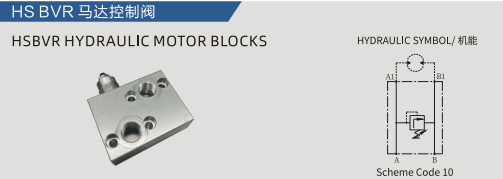
BVR hydraulic MOTOR BLOCKS are integrated units. They house essential components of a hydraulic motor. This simplifies installation, operation, and maintenance. These compact assemblies efficiently convert hydraulic fluid pressure into rotational mechanical energy. They drive various industrial and mobile applications. The global market for hydraulic manifold blocks, valued at USD 1.2 Billion in 2024, shows substantial growth. This trend underscores the increasing demand for such efficient hydraulic solutions.
Key Takeaways
- BVR MOTOR BLOCKS are single units. They turn fluid pressure into spinning power. This makes machines work.
- These blocks save space. They are strong and last a long time. They are also easy to set up and fix.
- BVR MOTOR BLOCKS help many machines. They are used in factories, construction, and farms. They keep machines running well.
Understanding How BVR MOTOR BLOCKS Work
From Fluid to Force: The Basic Principle
BVR MOTOR BLOCKS efficiently convert hydraulic fluid pressure into rotational mechanical energy. This process relies on fundamental physical principles. Hydraulic systems use incompressible hydraulic oil as a working medium. This oil transmits energy and controls motion through pressure. The basic working principle depends on the hydraulic oil’s ability to transmit pressure from one part of the system to another. This enables precise and powerful motion control. Pascal’s principle forms the basis for this force transmission. Pressurized fluid efficiently transmits force through pipelines.
Pascal’s principle states that fluid pressure in a closed container is equal at every point. Its direction is perpendicular to the surface. This allows for the transmission of force and pressure within the hydraulic fluid. A small force can move a heavy object. The hydraulic motor within the MOTOR BLOCK converts fluid energy into rotational mechanical energy. This conversion is a key part of the overall energy conversion process in a hydraulic system.
Key Components Within the MOTOR BLOCK
BVR MOTOR BLOCKS integrate several key components. These components work together to produce mechanical output. In many BVR MOTOR BLOCKS, a hydraulic piston motor performs the energy conversion. This motor converts the energy of pressurized hydraulic fluid into mechanical motion. It uses the reciprocating action of pistons within the motor housing. Radial piston motors, for example, position pistons radially around the central output shaft. These pistons move perpendicular to the shaft’s axis.
Pressurized fluid enters chambers behind the pistons. This pushes them outward against a cam ring or eccentric surface. This action forces the pistons to push on the cam ring. It causes the rotor and the connected output shaft to rotate. The synchronized and continuous movement of pistons ensures smooth torque delivery. As the output shaft rotates, pistons sequentially push outward and pull inward. This allows fluid to enter and exit through designed ports. This design results in high torque at low rotational speeds.
Key components of hydraulic radial piston motors often found within BVR MOTOR BLOCKS include:
- Cylinder Block: This rotating part contains bores for the pistons. It rotates with the output shaft.
- Pistons: Multiple pistons arrange radially within the cylinder block. They move in and out due to hydraulic pressure.
- Cam Ring or Eccentric Sleeve: This fixed or movable ring has a shaped internal surface. Pistons press against it, converting linear motion into rotation.
- Valve Plate: It directs hydraulic fluid flow into and out of piston chambers. This ensures correct timing.
- Output Shaft: Connected to the cylinder block, it transmits rotational energy to machinery.
- Seals and Bearings: These maintain fluid pressure and enable smooth, low-friction mechanical motion.
Other types of motors, like gear or vane motors, also exist. Gear-type hydraulic motors use pressurized fluid to force gears to rotate. Vane-type motors feature a slotted rotor with free-sliding rectangular vanes. Pressurized fluid strikes these vanes, causing rotation. Regardless of the specific motor type, the MOTOR BLOCK integrates these elements. This creates a compact and efficient unit for power conversion.
Why Choose BVR MOTOR BLOCKS: Key Advantages
BVR MOTOR BLOCKS offer significant benefits for hydraulic systems. They provide solutions that enhance efficiency, reliability, and ease of use. These advantages make them a preferred choice across many industries.
Compact Design and Space Efficiency
BVR MOTOR BLOCKS feature a highly compact design. This design integrates multiple hydraulic components into a single unit. This integration significantly reduces the overall footprint required for a hydraulic system. Modern compact hydraulic power units can reduce the footprint from a typical 2 m² to 0.5 m². This translates to a 75% space saving. Efficient manifold block designs and optimized reservoir shapes achieve this reduction. The compact nature allows for installation in smaller spaces. It also simplifies machine design and layout.
Enhanced Reliability and Durability
BVR MOTOR BLOCKS are built for long-lasting performance and high reliability. They achieve durability through the use of high-grade materials and adherence to strict quality standards. They operate consistently under high pressure and varying temperatures. Extensive quality control and durability testing further ensure robust performance. This helps maintain high performance and longevity, reducing maintenance needs and downtime.
BVR utilizes specific materials for their hydraulic components:
| Type of Material | Working Pressure (Mpa) | Thickness (mm) | Manufacturability | Weldability | Cost Factor |
|---|---|---|---|---|---|
| Hot-rolled steel sheet | ≈35 | <160 | Usual | Usual | 1 |
| Carbon steel forgings | ≈35 | >160 | Usual | Usual | 1.5 |
| Free Cutting Steel | ≈35 | Rods, Plates | Usual | Usual | 1.5 |
| Grey cast iron | ≈14 | —— | Good | Unacceptable | 2 |
| Ductile iron | ≈35 | —— | Usual | Unacceptable | 2.1 |
| Aluminium alloy forgings | ≈21 | —— | Good | Unacceptable | 3~5 |
The manufacturing process also contributes to their durability. This comprehensive process includes:
- Full CNC processing minimizes human error and ensures high consistency (up to 98%).
- Testing of raw materials.
- CNC machining.
- Burr repair.
- Surface grinding.
- Surface finish detection.
- Ultrasonic cleaning.
- External processing, such as nickel plating.
- Various gauge detections, including thread check gauge, hole inner diameter dial indicator detection, and thread ring gauge detection.
- Semi-finished products endoscopic detection.
- Product assembly.
- Assembly drawing comparison check.
Simplified Installation and Maintenance
The integrated design of BVR MOTOR BLOCKS simplifies both installation and maintenance. Combining multiple components into one unit reduces the number of external connections. This minimizes potential leak points. It also streamlines the assembly process. Technicians can install these units quickly. Their modular nature allows for easier troubleshooting and component replacement. This reduces downtime and labor costs.
Optimized Performance and Efficiency
BVR MOTOR BLOCKS are engineered for superior performance and efficiency. Their meticulously optimized internal structure enhances fluid dynamics. This design specifically aims to reduce energy loss. It ensures superior hydraulic transmission. This maximizes performance and efficiency within the hydraulic system. BVR motor blocks contribute to energy savings in hydraulic systems through this sophisticated internal structure. This optimization leads to improved efficiency and performance.
Applications and Maintenance of BVR MOTOR BLOCKS
Common Industries and Equipment
BVR MOTOR BLOCKS serve various industrial sectors. They provide reliable hydraulic power for many types of machinery. Industries like manufacturing widely use these units. They power conveyors, presses, and other industrial machinery. Construction machinery also benefits from BVR MOTOR BLOCKS. They power hydraulic systems in excavators, loaders, and cranes. Agricultural equipment, such as tractors, harvesters, and irrigation systems, also integrate these blocks. Furthermore, marine applications utilize BVR MOTOR BLOCKS in propulsion systems and deck machinery.
Specific equipment commonly integrates BVR hydraulic MOTOR BLOCKS. Industrial machinery includes injection molding equipment, die-casting machines, and metalworking machinery. Mobile equipment, such as bulldozers and loaders, relies on them. Harvesters and tractors in agriculture also use these blocks. Marine propulsion systems and deck machinery incorporate them for efficient operation.
Essential Maintenance Tips for Longevity
Proper maintenance ensures the longevity and optimal performance of BVR MOTOR BLOCKS. Regular fluid checks are crucial. Operators must monitor hydraulic fluid levels and quality. Contaminated fluid can cause significant wear. They should replace filters according to manufacturer guidelines. This prevents particulate matter from damaging internal components. Periodically inspect all connections and seals. This helps prevent leaks and maintains system pressure. Technicians should also check for unusual noises or vibrations. These often indicate potential issues. Addressing small problems promptly prevents larger failures. Adhering to a strict maintenance schedule maximizes the operational life of the MOTOR BLOCKS.
BVR hydraulic MOTOR BLOCKS offer an integrated, reliable, and versatile solution. They convert hydraulic power into mechanical motion. Their compact design, enhanced durability, and easy maintenance make them a superior choice for diverse applications. Exploring BVR’s range of motor blocks optimizes hydraulic system performance and efficiency.
FAQ
What is a BVR MOTOR BLOCK?
BVR MOTOR BLOCKS are integrated units. They house essential hydraulic motor components. These blocks convert fluid pressure into rotational mechanical energy. They simplify installation and maintenance.
What are the main benefits of BVR MOTOR BLOCKS?
BVR MOTOR BLOCKS offer compact design and space efficiency. They provide enhanced reliability and durability. These units also simplify installation and maintenance. They optimize performance and efficiency.
How does a BVR MOTOR BLOCK convert fluid pressure into mechanical energy?
A hydraulic motor within the block converts pressurized fluid energy. It uses pistons or gears to create rotational motion. This process efficiently transforms fluid power into mechanical output.